
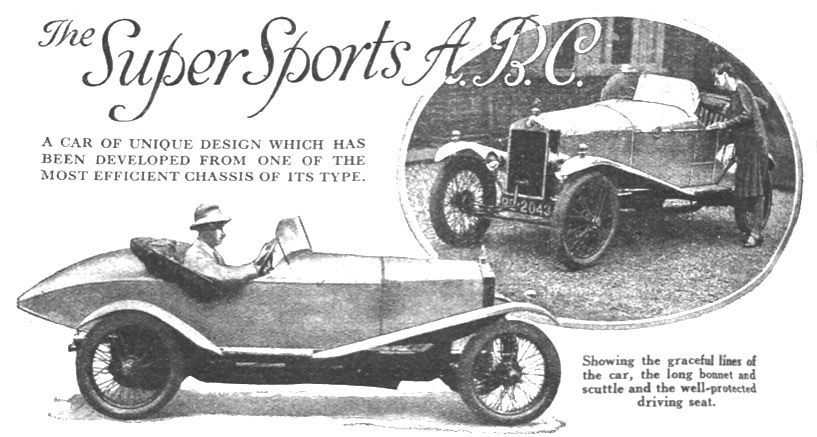
Road Tests of 1926 Models.
“ WHAT a perfectly delightful seat! " That is the first remark which anyone would make who settled himself behind the wheel of the latest A.B.C., A.B.C., which was introduced shortly after the war and which has always enjoyed considerable popularity amongst a comparatively small, but very enthusiastic, number of motorists.
This new model does not differ in any material respects from the original design; it is merely details which have been modified, some of these being of an important nature, whilst others are of little apparent consequence.
Those. of our readers who are familiar with the original type of .A.B.C. will remember that the only bad words which could be said for it were that the engine was too noisy, had valve gear of a design which was clearly open to improvement, was much too fond of oiling up its off-side plug, and was not wholly free from trouble due to cylinder barrel distortion. All of these defects have been eliminated, whilst a number of other improvements have been made.
Originally, the A.B.C. engine developed about 27 b.h.p. and, when in good ,fettle, pulled extraordinarily well; the performance of the car was, in fact, well ahead of others of contemporary design. To-day the engine gives between 35 b.h.p. and 40 b.h.p., arid should be absolutely reliable.
New Features.
Turning to the alterations which have been made, we may well start with the crankshaft, which Is now much stronger than of yore, whilst the big-end journals have been altered to allow for double-row roller bearings. This has called for alterations in the design of the connecting rods, and these are now very strong indeed.
Aluminium pistons of a light and efficient pattern figure in the latest specification and cast-iron cylinder barrels replace the turned steel ones previously used.
The difficulty at one tire experienced with the lubrication of A.B.C. engines has been entirely overcome by the adoption of a dry-sump system. The layout consists of a large tank slung beneath the engine. The lubricating oil is sucked up from this by a motorcycle type of pump, which delivers it to a pair of adjustable sight feeds on the facia-board. These deliver direct to the cylinder barrels and careful adjustment or them ensures that the engine is always adequately lubricated, whilst there is little risk of oiling up the plugs. Surplus oil returns from the crankcase to the oil tank, where it is recirculated.
The improvements which have been effected to the valve gear are far-reaching. They have led to very much more silent operation and should definitely prevent unduly rapid wear of the parts concerned. It will be remembered that the early rocker gear was offset and this caused the rockers and pins to wear very rapidly. On the latest design the stagger bas been avoided. All the parts have been made of ample size and the whole mechanism is enclosed and lubricated by oil vapour, which reaches the cylinder heads along tubes from the crankcase, which also serve to enclose the push-rods.
Improved Brakes.
So far as the chassis is concerned, one notices few alterations from the earlier design. A notable improvement, however, is the use of cast-iron shoes for the external-contracting brake, in place of the steel bands which figured in the specification of earlier models. The new shoes carry Ferodo linings and operate upon the same drums on the back wheels as those used for the internal-expanding hand brake.
The car which we tested had only rear-wheel brakes but front-wheel brakes of the Whitehead type are available at an extra charge of 12 guineas. .An extra which figured in this particular car was Rudge-Whitworth wire wheels. These cost 15 guineas more than the disk wheels which are included in the standard price of the car £275.
The A.B.C. is now the only air-cooled two-cylinder-engined light car on the market, and it may be said with safety that it represents the first determined effort to offer to the public a really high-efficiency engine of this type.
It will be gathered from the brief summary of its specification that the engine follows the latest practice and it has only to be driven for one to realize that its performance bears out the impressions which an examination of It conveys.
One is struck immediately the bonnet is raised by the presence of two Zenith triple-diffuser carburetters and nicely swept exhaust pipes of considerable diameter.
Taking over the car from the manufacturer – A.B.C. Motors, Ltd., Walton-on-Thames, Surrey - we were soon accustomed -to the rather remarkable A.B.C. gear change, which is unique in that the gate is vertical instead of horizontal. To engage first gear one presses down on the gear-lever knob and pushes it forward, second is straight back, third forward-up-forward, and top straight back. Reverse is in the same compartment of the gate as first, but farther forward.
The steering of this car is very delightful indeed. Truly irreversible, it is light to a degree, and gives a sense of control which others might well regard as a standard of efficiency worth seeking. The three pedals, which are conventionally placed, are convenient to operate and the central hand-brake lever comes nicely to hand without interfering with the gear lever. This brake, however, is not so powerful as it might be, whilst the ratchet mechanism might be modified with advantage to make it more easy for the brake to be released.
The foot brake is very powerful, but, with so fast a car, one has come to regard front-wheel brakes as almost essential.
The acceleration of this A.B.C. is quite exceptional. We are informed that, with skilful handling of the gear lever, it can achieve a speed or 50 m.p.h. from a standstill in 15 seconds, but apparently we bad not the dexterity to make it do this ourselves. the best figure we obtained being 19 seconds. which must be regarded, nevertheless, as very good indeed.
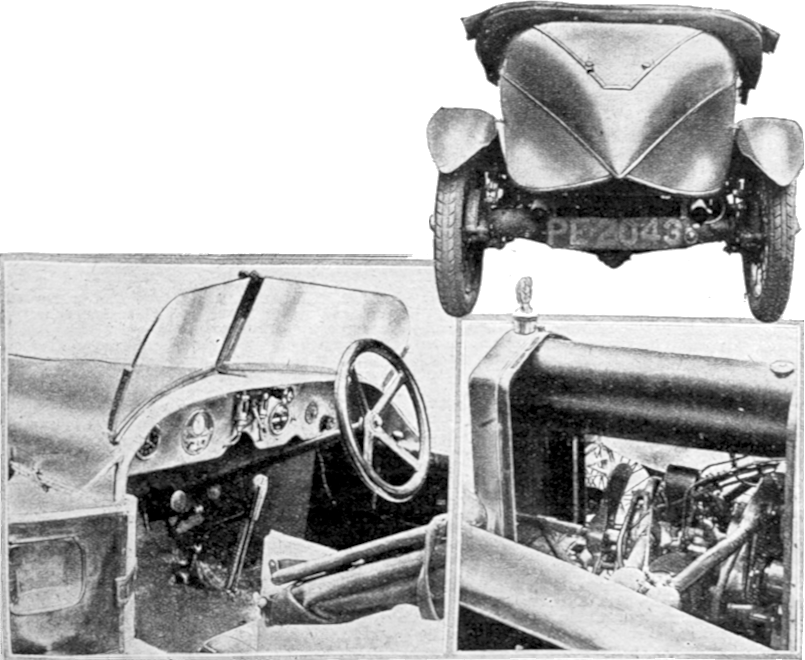
The cockpit is nicely planned and all the controls are convenient.
The rear view of the car shows the massive axle and new brakes, whilst the twin exhausts are also visible.
The latest engine differs in many respects from earlier models.
Details of Performance.
On the gears the following speeds are comfortably obtainable: -First (18.36 to 1), 17 m.p.h.; second (13.77 to 1), 32 m.p.h.; third (6.5 to 1), 47 m.p.h.; top (4.5 to 1), 60 m.p.h. These speeds can be improved by flogging the engine somewhat, whilst a maximum speed of 70 m.p.h. would not be out of the question. We ourselves pushed the car up to 65 m.p.h., and held that speed over a measured mile without noticing undue vibration.
It is peculiar that a car of this type should have a good top-gear performance, for not only has it a "hot-stuff'" valve timing, but it is also essentially of a type which is popularly supposed to thump except when revving. In point of fact, the A.B.C., in its latest form, will poll strongly on top gear down to 10 m.p.h. without knocking - on National benzole mixture - whilst it will accelerate from 10 m.p.h. to 50 m.p.h. entirely on top gear in 29 seconds.
So far as the comfort of the occupants is concerned, we have mentioned already that the driving seat is really excellent in this respect, whilst the passenger's seat is also quite exceptionally good. Both seats have pneumatic upholstery and are almost level with the floor.
The sides of the car being high, and the back especially so, the occupants are very well protected, back draught and side winds not being noticeable. This is brought about largely by the use of a sloping V screen of the sports type, but this would have distinct limitations in wet weather, as the hood makes but a poor joint with the top of it.
If a third passenger has to be carried, the lid can be removed from the tail, disclosing a very roomy boot, which houses the spare wheel - lying flat on the floorboards - and which could easily accommodate an improvised bucket seat for a passenger.
The springing of the car, which is aided by friction-type shock absorbers at the rear only, is splendid from the point of view of road holding, does not allow the car to roll to the slightest extent on corners, but must be described as distinctly on the "hard" side. High-pressure tyres (710 mm. by 90 mm.) are fitted.
Whilst in our bands, the car covered 210 miles, the petrol consumption for this distance averaging 26 m.p.g., whilst a pint and a quarter of oil was used. The carburetters had size 23 chokes and 95 main jets, which is a speed setting. For drivers who would be satisfied with 60 m.p.h. flat out, the consumption, we understand, would be better than 30 m.p.g.
From "The Light Car and Cyclecar" - July 30th, 1926